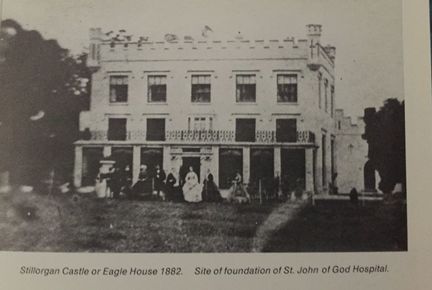
Photograph courtesy of Brother Kilian, St John of God Hospitaller
|
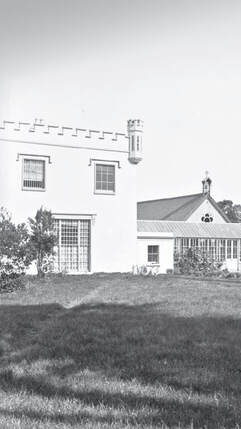
Detailing of the roof of the castle taken between 1882 and 1908 from the Lawrence Collection. https://catalogue.nli.ie/Record/vtls000325611
|
Stillorgan Castle
NAME Eagle House/Mount Eagle/Stillorgan Castle/House of St John of God
AREA LOCATION STILLORGAN,
MAP LOCATION OSI maps of 1838-1845 and 1898-1913 place it in the townland of
Stillorgan Park and it is annotated as Stillorgan Castle and House
of St John of God respectively.
GENERAL Frequently noted as the site where the Wolverston family lived
at Stillorgan Manor House ,however the Manor lands were more likely to have
been at the site of Stillorgan Park House as per Rev N Donnelly DD (Lord Bishop of
Canea).
It is thought to have been known as Mount Eagle or Eagle House locally as it had
three stone eagles mounted on the roof with miniature bartizans at each corner.
There is also some evidence that it was colloquially known as The House of Lords
during the tenure of Henry Deane Grady due to his daughters having all made
extremely good matches.
In 1836 it was to let or the interest in the lease sold on 20 acres. It was described as a
first rate residence with four reception rooms, a library and billiard room with six
bedrooms. There were water closets and servant's accommodation in the basement.
It was again for sale in 1842/3 on 23 acres (37 statute acres) and advertised by Guinness
& Mahon as being suitable for a family of distinction.
It was purchased in 1882 by the Brothers of St John of God as a "House of Retreat for the
old and the Invalid" and enlarged using granite from the Dublin mountains near
Stepaside. A cemetery was opened on the site in 1884. The hospital was further
enlarged in 1890 when a community wing and chapel were added. On the
25 Nov 1908 the main house burned to the ground. Fire appliances arrived from
Blackrock, Tara Street and Sir James Talbot Power of Leopardstown Park came to their
aid with his own fire appliance. Offers of help were forthcoming from various local
landowners including Dr Peacocke and Marcus Goodbody of Obelisk Park. The fire was
thought to have been started by a spark from a chimney which ignited the clock tower.
By 1911 a new building had emerged from the ashes, little survived the fire and what
did survive was subsequently damaged. The largest of the roof eagles survived, was
restored, and is now situated close to the church. Another fire in 1942 on a ward
threatened the building but Dun Laoghaire fire brigade got it under control.
In 1977 part of the land fronting on to the road was acquired by Dublin County Council
for the new dual carriageway. The gatelodge and swimming pool were demolished and
the railings were moved to St John of God Islandbridge and a semi circular drive was installed.
YEAR BUILT circa 1820
VALUATION In 1910 the valuation was 540 pounds and in the 1901 census it
was home to 118 persons and had 94 windows to the front.
ARCHITECT Original building unknown. 1913 Chapel - Mr Thomas Kinsella,
builder, Stillorgan. Windows by Early & Co Dublin.
SOURCES Thom’s directories, Registry of Deeds, contemporaneous
newspapers, Griffith's Valuation, NAI Census & Wills, F E Ball and
OSI Maps.
OCCUPANTS
1795 - 1808 William Monck Mason
1809 - 1858 Henry Deane Grady
1846 - 1858 Captain Robert Deane Grady
1858 - 1882 David Sherlock
1867 - 1868 Robert William Hillas
1882 - todate The Brothers of St John Of God
STAFF
1849 John Doyle, Gatekeeper
1851 Susan Bennett - Nurse
1869 - 1871 William Keough - Steward (Mary Cummins - wife)
1898 Maurice Doyle - Waiter living in Kilmacud
1901 James Dolan - Lodge keeper
Michael Byrne - Labourer living in Kilmacud
1904 - 1953 William Traynor - living at gatelodge
1904 - 1971 Esther Traynor - living at gatelodge
1911 Edward Traynor - Night Watchman
William Morris - Attendant
William Doran - Attendant
Michael Bohan - Attendant
Patrick Neill - Attendant
Patrick Prior - Attendant
Joseph Gallagher - Attendant
Thomas Boylan - Farm Servant
Patrick Coen - Domestic Servant
1911 Thomas Leonard - Attendant
1911 - 1914 Peter Rice - Cook
1920's John Goodwin
1921 Michael Bird
Laurence (Sweeny) Sweeney - Attendant
1924 -1928 William Harrington - Asylum Attendant
PATIENTS
CURRENT
STATUS Extant and in use as a hospital run by St John of God Hospitaller.
CONTRIBUTORS ©June Bow & Karen Poff
DATE May 2017
NAME Eagle House/Mount Eagle/Stillorgan Castle/House of St John of God
AREA LOCATION STILLORGAN,
MAP LOCATION OSI maps of 1838-1845 and 1898-1913 place it in the townland of
Stillorgan Park and it is annotated as Stillorgan Castle and House
of St John of God respectively.
GENERAL Frequently noted as the site where the Wolverston family lived
at Stillorgan Manor House ,however the Manor lands were more likely to have
been at the site of Stillorgan Park House as per Rev N Donnelly DD (Lord Bishop of
Canea).
It is thought to have been known as Mount Eagle or Eagle House locally as it had
three stone eagles mounted on the roof with miniature bartizans at each corner.
There is also some evidence that it was colloquially known as The House of Lords
during the tenure of Henry Deane Grady due to his daughters having all made
extremely good matches.
In 1836 it was to let or the interest in the lease sold on 20 acres. It was described as a
first rate residence with four reception rooms, a library and billiard room with six
bedrooms. There were water closets and servant's accommodation in the basement.
It was again for sale in 1842/3 on 23 acres (37 statute acres) and advertised by Guinness
& Mahon as being suitable for a family of distinction.
It was purchased in 1882 by the Brothers of St John of God as a "House of Retreat for the
old and the Invalid" and enlarged using granite from the Dublin mountains near
Stepaside. A cemetery was opened on the site in 1884. The hospital was further
enlarged in 1890 when a community wing and chapel were added. On the
25 Nov 1908 the main house burned to the ground. Fire appliances arrived from
Blackrock, Tara Street and Sir James Talbot Power of Leopardstown Park came to their
aid with his own fire appliance. Offers of help were forthcoming from various local
landowners including Dr Peacocke and Marcus Goodbody of Obelisk Park. The fire was
thought to have been started by a spark from a chimney which ignited the clock tower.
By 1911 a new building had emerged from the ashes, little survived the fire and what
did survive was subsequently damaged. The largest of the roof eagles survived, was
restored, and is now situated close to the church. Another fire in 1942 on a ward
threatened the building but Dun Laoghaire fire brigade got it under control.
In 1977 part of the land fronting on to the road was acquired by Dublin County Council
for the new dual carriageway. The gatelodge and swimming pool were demolished and
the railings were moved to St John of God Islandbridge and a semi circular drive was installed.
YEAR BUILT circa 1820
VALUATION In 1910 the valuation was 540 pounds and in the 1901 census it
was home to 118 persons and had 94 windows to the front.
ARCHITECT Original building unknown. 1913 Chapel - Mr Thomas Kinsella,
builder, Stillorgan. Windows by Early & Co Dublin.
SOURCES Thom’s directories, Registry of Deeds, contemporaneous
newspapers, Griffith's Valuation, NAI Census & Wills, F E Ball and
OSI Maps.
OCCUPANTS
1795 - 1808 William Monck Mason
1809 - 1858 Henry Deane Grady
1846 - 1858 Captain Robert Deane Grady
1858 - 1882 David Sherlock
1867 - 1868 Robert William Hillas
1882 - todate The Brothers of St John Of God
STAFF
1849 John Doyle, Gatekeeper
1851 Susan Bennett - Nurse
1869 - 1871 William Keough - Steward (Mary Cummins - wife)
1898 Maurice Doyle - Waiter living in Kilmacud
1901 James Dolan - Lodge keeper
Michael Byrne - Labourer living in Kilmacud
1904 - 1953 William Traynor - living at gatelodge
1904 - 1971 Esther Traynor - living at gatelodge
1911 Edward Traynor - Night Watchman
William Morris - Attendant
William Doran - Attendant
Michael Bohan - Attendant
Patrick Neill - Attendant
Patrick Prior - Attendant
Joseph Gallagher - Attendant
Thomas Boylan - Farm Servant
Patrick Coen - Domestic Servant
1911 Thomas Leonard - Attendant
1911 - 1914 Peter Rice - Cook
1920's John Goodwin
1921 Michael Bird
Laurence (Sweeny) Sweeney - Attendant
1924 -1928 William Harrington - Asylum Attendant
PATIENTS
CURRENT
STATUS Extant and in use as a hospital run by St John of God Hospitaller.
CONTRIBUTORS ©June Bow & Karen Poff
DATE May 2017